Problem
Consumer electronics makers want speech, vision and small language models running on device, but each product line ships with a different neural chip and every vendor toolchain behaves differently. One appliance maker told us that porting a wake-word model and a vision model to three chip families took six engineers four months, and accuracy still dropped after quantisation.
Solution
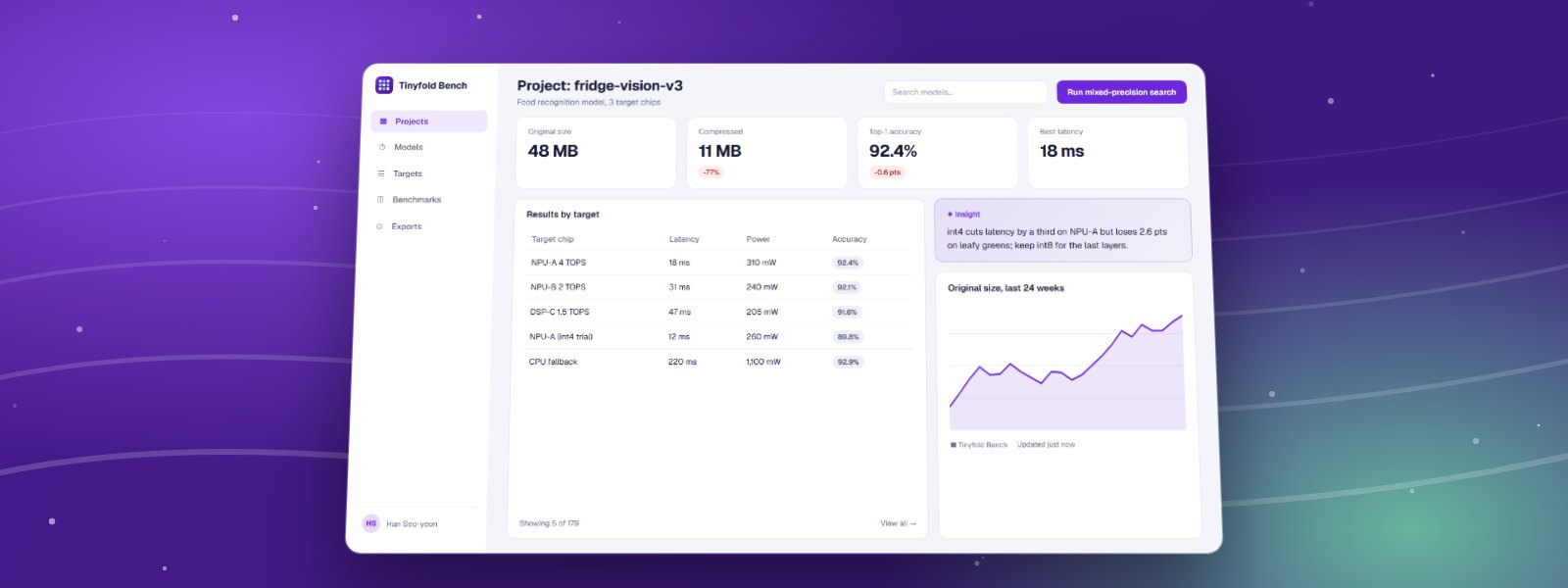
Tinyfold takes a trained model, searches quantisation and pruning settings layer by layer, and compiles it for the target chip, checking accuracy against the customer's own test set at each step. Engineers see size, latency, power and accuracy side by side for 14 supported chips and export a ready-to-flash package in hours instead of months.
Target market
Device makers in Korea, Japan, Taiwan and China shipping over 1 billion products a year with neural chips; on-device AI tooling spend is projected to approach US$2B by 2029.
Business model
Annual licence for engineering teams starting at US$60K, plus a per-device royalty of a few cents once a compiled model ships in volume.